Zerg AI
A Compiler for Software Specifications
You write a manifest that defines what the software should do, what tests it should pass, and what rules it should follow. Zerg compiles that into working, production-grade software — autonomously.
Configured rather than directed. Infrastructure, not IDE.

How Zerg Works
Three steps. No human in the loop for routine changes.
Sense
Zerg monitors your codebase: repos, tests, logs, APIs. It perceives the living codebase and detects when something changes.
Adapt
When an API updates, a dependency shifts, or a new requirement lands — Zerg generates and validates the fix automatically.
Converge
Each cycle moves closer to a stable solution. No human approval required for routine changes. Software that maintains itself.
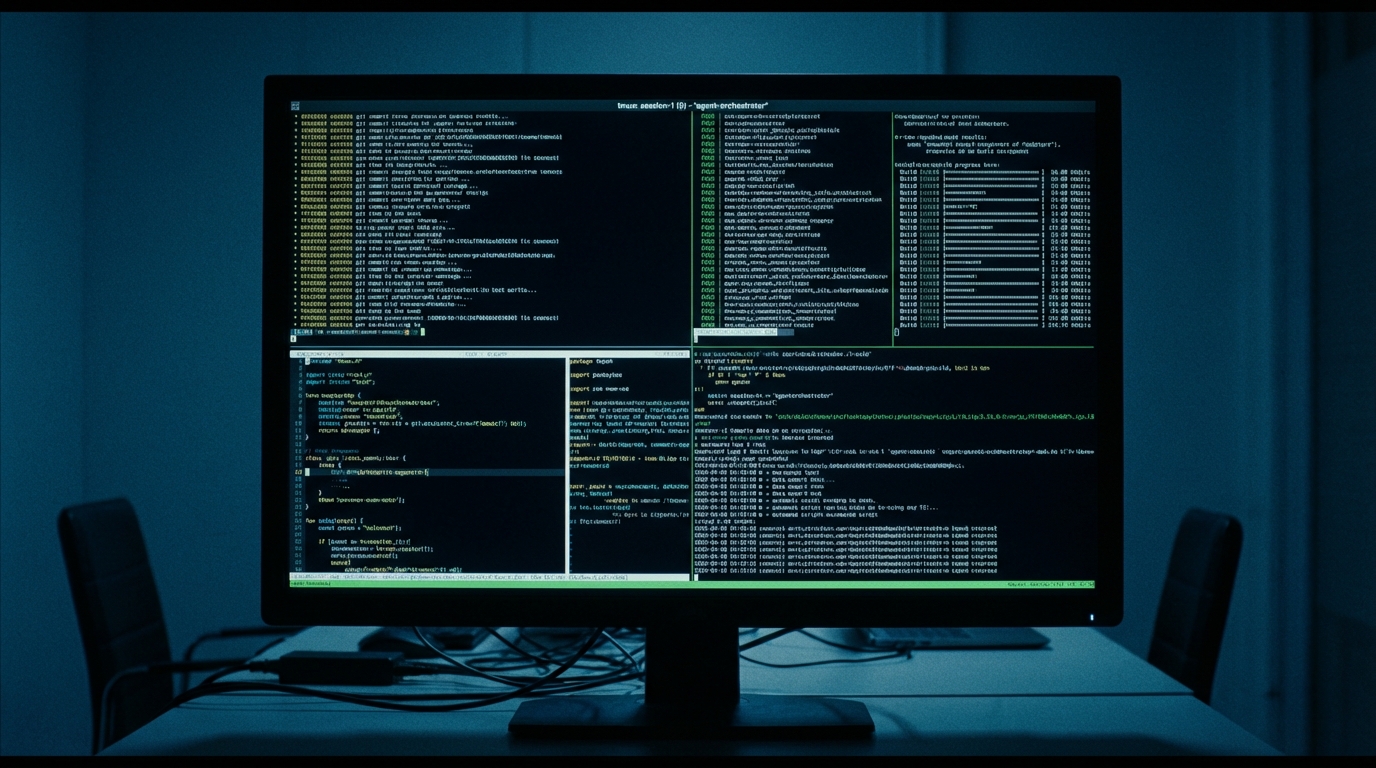
Multiple AI agents working in parallel — the orchestrated swarm.
Proof It Works
Andesite
Enterprise security platforms
Andesite needed to scale from 10 data connectors to 200. The old way: 60 engineer-years of work. $12M to build. $500K/year to maintain.
"Even a 30% speedup would save us thousands of engineering hours."
— Alex Thaman, CTO @ Andesite
We delivered over 90%.
This isn't incremental improvement. It's a category shift.
Why This Compounds
Every deployment makes Zerg smarter.
Each engagement funds the company, trains the engine, and produces proof points that unlock the next tier. We're not just building revenue — we're building an unfair advantage that compounds with every customer.
Why This Is Different
Not an assistant. Not a copilot. A fundamentally different category of tool.
Text editors need a human at the keyboard
AI coding assistants are very good text editors. You sit next to them, tell them what to do, review the output, tell them what to fix. The human is the program.
Compilers need a specification
Zerg is a compiler. You write the spec, hit compile, walk away. The system knows what "done" looks like and drives toward it. The spec is the program.
"Zerg continually re-evaluates its own codebase against a set of changing requirements. A 24/7 system, finding where there's a gap between expectation and reality, and bringing things back into balance."

At a million tokens per second, you're not writing software. You're building worlds.
The flywheel is turning.
Zerg-generated code is live in production at enterprise customers today.